

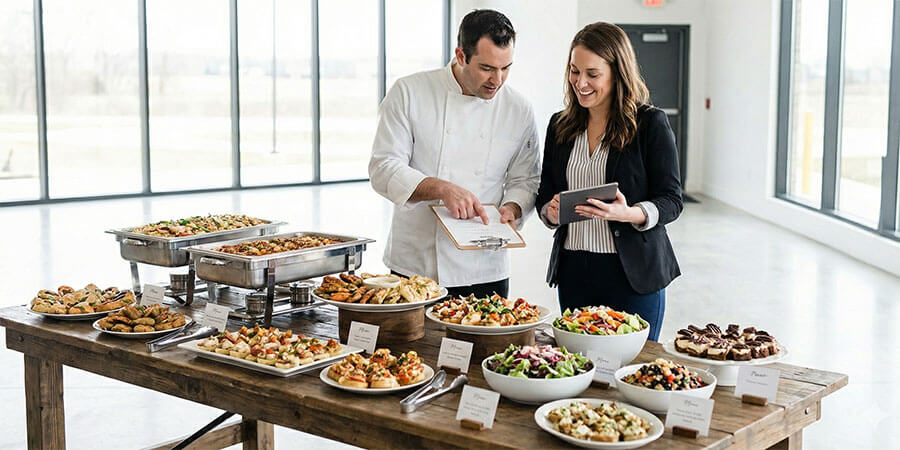
Choosing the right food for your guests is one of the most important decisions you will make when planning any event. Whether you are organising a corporate lunch in the Sydney CBD, a birthday celebration in the Northern Beaches, or a summer Christmas party in the Eastern Suburbs, the menu you put together will shape how people remember the day. Getting it right means understanding your crowd, knowing what is in season, and working with a trusted professional caterer who can bring your vision to life. This guide walks you through exactly how to do that, step by step.
Key Takeaways
- Always collect dietary requirements from guests well before the event date
- Seasonal NSW produce delivers better flavour and supports local growers
- A well-planned menu covers vegan, gluten-free, and allergen-free options as standard
- Working with an experienced caterer saves time, reduces waste, and lifts the overall guest experience
- Sydney event styles vary across suburbs, so tailor your menu to the local crowd and venue
Start With Your Guests, Not the Food
It sounds simple, but many event planners make the mistake of starting with a menu they personally love rather than one that suits the room. Before you think about whether you want grazing platters or a shared buffet, ask yourself a few basic questions.
How many guests are coming? A boardroom lunch for 20 people in the Hills District needs a very different approach to a cocktail party for 150 in Western Sydney. What is the occasion? A product launch calls for smart, elegant finger food, while a team celebration might call for something more relaxed, like a BBQ spread. What time of day is the event? Morning conferences need a completely different spread compared to an evening gala.
Once you have answers to those questions, the menu planning becomes far easier.
Collecting Dietary Requirements Early
This is where many event organisers fall behind. Collecting dietary requirements early, ideally two weeks before the event, gives you enough time to plan proper options rather than patching things together at the last minute.
Sydney is a wonderfully diverse city. At any given event, you might have guests who are vegan, vegetarian, gluten-free, halal, kosher, nut-allergic, dairy-free, or following a low-FODMAP diet. The good news is that dietary inclusivity is no longer a niche concern. It is now expected as standard, especially in corporate environments.
When you send out your event details, include a simple field asking guests to share any dietary needs. Keep the question open-ended so nobody feels left out, and pass that information directly to your caterer as soon as possible.
A professional caterer in Sydney will already have strong systems for handling dietary requirements across large groups. They can flag allergens, prepare dedicated options, and label dishes clearly, so guests always know what they can eat without having to ask.
Think About the Style of Service First
Before settling on specific dishes, you need to decide how food will be served. The service style shapes everything from the type of food chosen to how much staff you will need on the day.
Here is a quick overview of the most common options and when they work best:
| Service Style | Best For | Typical Setting |
| Cocktail canapés and finger food | Corporate launches, evening events, cocktail parties | Standing events, rooftop venues |
| Shared platters and grazing | Team celebrations, birthday parties, casual corporate lunches | Indoor/outdoor seated or semi-standing |
| Shared buffet | Conferences, large-scale events, multi-course functions | Seated events with sufficient space |
| Individual lunch boxes or bento | Workshops, training days, conference breakout sessions | Seated corporate settings |
| BBQ and paella stations | Outdoor events, Australia Day celebrations, end-of-year parties | Outdoor venues, parks, sporting facilities |
| Plated and seated dining | Formal dinners, awards nights, weddings | Restaurant-style venues |
For summer Christmas parties across the Inner West or Sutherland Shire, outdoor BBQs and shared grazing tables tend to be a crowd favourite. The warm weather, longer evenings, and relaxed Australian vibe make them a natural fit. A skilled caterer will help you match the service style to your venue and guest list, taking into account logistics like kitchen access, serving staff, and timing
Use Seasonal NSW Produce for Better Flavour and Value
One of the smartest things you can do when building a catering menu for a Sydney event is to lean into what is actually in season. NSW grows an incredible range of produce throughout the year, and seasonal ingredients always taste better, travel fresher, and often cost less because they do not need to be imported.
Here is a simple seasonal guide for NSW events:
Summer (December to February): Sydney summers are ideal for light, fresh menus built around stone fruits like mangoes, peaches, and cherries; ripe tomatoes and capsicum; fresh prawns and seafood; and bright salads loaded with herbs. Christmas party menus in particular benefit from a summery spread with whole prawns, fresh ceviche, vibrant fruit platters, and chilled beverages rather than the heavy roasted meats more commonly seen in the Northern Hemisphere.
Autumn (March to May): Root vegetables come into their own during autumn in NSW. Think sweet potato, pumpkin, and beetroot. Mushrooms are at their best, and stone fruits start making way for citrus. This is a great time for warm, hearty canapés and nourish bowls.
Winter (June to August): Winter in Sydney is mild compared to much of the world, but guests still appreciate warming dishes. Soups served in cups, slow-cooked meats, hearty salads with roasted vegetables, and warming pastries all go down well.
Spring (September to November): Spring brings asparagus, broad beans, peas, and fresh leafy greens. It is also a wonderful time to showcase lighter dishes, fresh sushi platters, and vibrant nourish bowls packed with colour.
When you work with a professional caterer in Sydney, they will already be thinking about what is available locally and what delivers the best result at that time of year. They have supplier relationships that give them access to quality produce that is not always available through standard retail channels.
Plan for Vegan and Gluten-Free Guests as a Matter of Course
It used to be that a vegan option was a single sad plate sitting to the side of the main spread. That approach no longer reflects the expectations of Sydney’s corporate and event audiences. Today, vegan catering and gluten-free catering should be woven into the menu at every course, not bolted on as an afterthought.
Research from Food Standards Australia New Zealand shows that around one in six Australians actively seek out plant-based options when dining out. In a corporate context, with a diverse guest list drawn from across Sydney, that figure can be even higher.
A great catering menu in Sydney handles plant-based and allergen-free needs in a way that guests barely notice. The vegan arancini sits comfortably next to the prawn skewers. The gluten-free wraps are just as generously filled as the standard ones. Nobody feels like they are missing out, and nobody has to single themselves out to ask what they can eat.
When briefing your caterer, simply tell them the percentage of guests with specific requirements and ask how they handle labelling on the day. A good caterer will have this process locked in.
Zero-Waste Catering Practices Are Now Expected
Sustainability is not just a buzzword in Sydney’s events industry. It is something clients, guests, and venues increasingly expect to see in practice. A growing number of event planners across the Eastern Suburbs and Sydney CBD are specifically requesting zero-waste catering approaches, and professional caterers are responding with concrete solutions.
What does zero-waste catering actually look like in practice? It means using eco-friendly disposables when crockery hire is not possible, composting food waste rather than sending it to landfill, ordering quantities that match actual guest numbers rather than over-catering by a wide margin, using seasonal produce that has not travelled from overseas, and packaging any surplus food for donation or collection rather than throwing it away.
Some Sydney caterers have also shifted to biodegradable and compostable serving ware as a default option for events where washing up is not practical, like outdoor festivals or large corporate picnics in parks across Western Sydney.
When asking a caterer about their sustainability practices, look for specifics rather than vague commitments. Ask about their packaging suppliers, their food-surplus policies, and whether they partner with any local charities or food rescue organisations.
Matching the Menu to the Venue and Location
Sydney is a city of distinct neighbourhoods, and the suburb where your event is held can actually shape what kind of menu feels right. An event on the Northern Beaches might call for a fresh, coastal-inspired spread built around seafood, salads, and light finger food. A corporate function in the Sydney CBD might suit something more refined and structured, like individual plated meals or an elegant cocktail package. A team celebration out in the Hills District often works beautifully as a relaxed shared buffet or BBQ.
Venue considerations also play a practical role in what is possible. Not every venue has a commercial kitchen. Some locations are outdoors with limited facilities. Others have strict rules about open flames or catering suppliers. A professional caterer who regularly works across Sydney’s different suburbs and event spaces will know what is logistically achievable at each type of venue and will advise you accordingly before you commit to a menu style.
Transport time also matters. If food needs to travel from a preparation kitchen to a venue in the Sutherland Shire or the Inner West, the caterer needs to account for that in how dishes are packaged, reheated if needed, and presented on arrival.
How to Brief a Caterer Properly
One of the most common complaints from event planners is that they did not get the menu they were expecting, not because the caterer did a poor job, but because the original brief was too vague. A clear, detailed brief is the foundation of a great catering outcome.
When reaching out to a professional caterer for a quote, try to include the following:
- Event details: Date, time, duration, and location including suburb and postcode.
- Guest numbers: Confirmed if possible, or a range. Be honest about uncertainty because caterers build quantities around this number.
- Occasion type: Is this a corporate lunch, a birthday, a conference, a cocktail party, or a Christmas celebration?
- Service style preference: Do you have an idea of whether you want finger food, a buffet, individual boxes, or something else?
- Dietary breakdown: As detailed as you can manage. Even rough percentages help.
- Budget per head: This gives the caterer the parameters to build the right menu without going back and forth unnecessarily.
- Venue access details: Whether there is a kitchen, parking for a delivery vehicle, a lift to the function floor, and any restrictions the venue has on suppliers or open flames.
The more context you give, the better the proposal you will receive. A good caterer will ask follow-up questions even after a thorough brief, because getting the details right matters to them as much as it does to you.
The Real Benefit of Hiring a Professional Caterer
It is possible to organise food for an event yourself, but the gap between a self-catered event and a professionally catered one is enormous, and most guests notice the difference immediately.
A professional Sydney caterer brings not just cooking skill but also event knowledge, supplier relationships, food-safety compliance, staffing capability, and the ability to handle the unexpected with calm. When a dish runs out faster than expected, when a guest has an allergy nobody mentioned, when the venue runs 30 minutes behind schedule, a professional team adapts without the event planner ever needing to know.
Beyond logistics, professional catering simply tastes better. That is not a small thing. Food is one of the most powerful ways people form memories at events. Guests may forget the presentations, but they will remember the food. A corporate client who was served a gorgeous seafood grazing table at a product launch in the Sydney CBD will associate that positive feeling with your brand.
According to a 2023 report by Eventbrite, 63 percent of event-goers list food and beverage quality as one of the top three factors that determine whether they rate an event positively. That is not a small detail. It is a central part of the guest experience.
Working with an experienced caterer also takes an enormous amount of pressure off the event organiser. Rather than spending the morning of your event running between the kitchen and the function room, you can focus on your guests, your content, and the business of the day.
Case Study: Corporate Lunch in the Sydney CBD
A professional services firm based in the Sydney CBD needed catering for a 60-person client appreciation lunch. The guest list included senior executives, several of whom were vegan, and a number of international clients from different cultural backgrounds with varied dietary needs.
The event planner briefed their caterer six weeks out, providing a full dietary breakdown and requesting a menu that felt premium without being stuffy. The caterer proposed a shared platter format featuring a mix of warm and cold dishes, with clearly labelled vegan, gluten-free, and halal options built into every course.
On the day, the setup was complete before guests arrived. Staff circulated throughout the lunch to replenish platters and answer questions. Eco-friendly serving ware was used to reduce the environmental footprint of the event. Post-event feedback from guests rated the food and service as the highlight of the afternoon.
The event planner noted that the caterer’s ability to handle diverse dietary needs without making any guest feel singled out was one of the most appreciated aspects of the entire event. That kind of outcome is what a well-planned menu, combined with experienced execution, actually delivers.
Quick Tips for Getting Your Catering Menu Right
Here are some simple guidelines to keep in mind as you plan:
Always confirm final guest numbers at least 72 hours before the event. Most caterers will need this to finalise quantities.
For events running longer than two hours, plan for multiple food moments rather than one big spread. Guests who arrive at different times appreciate having something available throughout.
Match portion sizes to the time of day. A breakfast or morning tea requires lighter portions than a full lunch or dinner function.
If your event includes alcohol, always provide substantial food options. Light finger food is not enough when beverages are being served for several hours.
For outdoor summer events in Sydney, keep food safety front of mind. Dishes that include prawns, dairy, eggs, or poultry need to be kept at the right temperature, especially in January and February heat.
Label everything clearly on the day, even if you have already communicated dietary information to guests in advance. People feel more comfortable eating when they can confirm for themselves what is in a dish.
Frequently Asked Questions
How far in advance should I book a caterer for a Sydney event?
For large events of 100 or more guests, booking three to six months ahead is wise, especially for end-of-year Christmas parties where caterers fill their calendars quickly. For smaller events, four to eight weeks is generally sufficient, though popular dates in December can book out much earlier.
How many canapés should I allow per person at a cocktail party?
A general guide for a two-hour cocktail event where food is the main offering is eight to ten pieces per person. If dinner follows, reduce this to four to six pieces. If the event runs three or more hours without a seated meal, allow twelve or more pieces per person.
What is the difference between delivered catering and staffed event catering?
Delivered catering, sometimes called drop-off catering, involves food being prepared and delivered to your venue ready to serve. It is ideal for office lunches, smaller gatherings, and events where you have the team to handle serving. Staffed event catering includes a team of professionals who set up, serve, and pack down, making it the better option for formal events, large guest numbers, or occasions where you want a hands-off experience.
Can a caterer handle last-minute dietary additions?
A good caterer will do their best, but dietary requirements added within 24 to 48 hours of an event can be challenging to accommodate at a high standard. The earlier you communicate dietary needs, the better the result will be for everyone.
Is it worth hiring a caterer for a small office team of 10 to 15 people?
Yes, absolutely. Professional catering is available and practical for small groups, and many caterers offer delivered options that make it very straightforward and affordable for a lunch meeting, morning tea, or small team celebration.
Wrapping Up
Selecting the perfect catering menu for your guests comes down to three things: knowing your audience, working with what the season has to offer, and partnering with a caterer who has the experience and passion to bring it all together. Whether you are planning a Christmas party in the Eastern Suburbs, a conference in the Hills District, or a cocktail function in the Sydney CBD, the right food will always be one of the things your guests remember most.
Getting that right is easier when you work with people who do it every day.
